Looking for profitable niches with low competition? These are the ten I would look at today: wearable technology, dog training, maternity clothing, eco-friendly products, van life, home fitness, fast recipes, massage chairs, AI marketing and home automation. Each one comes with 10 sub-niche ideas, because that is where the real low competition niches are.
Why sub-niches? A broad niche like dog training gets 165,000 searches a month in the US, and every big pet brand wants that traffic. A narrower angle, like separation anxiety or agility training, still has buyers and far fewer sites going after it.
Picking a niche only because it’s popular is the fastest way to waste months on a site nobody finds. You need demand and a way to make money, but you also need room to rank. And you don’t want to find out you had none of that after 50 articles, do you?
Can you still find high traffic low competition niches, or rank in a competitive niche with a new site? Sometimes, if you go narrow enough. I’ll show you how further down.
So I did the research for you. Below you’ll find the most profitable niches with low competition for 2026, re-checked with fresh US search data, plus the steps I’d follow to find niches with low competition on your own.
Let’s get to it.
*Oct 2026 Update: I have rewritten this guide, kept the niche list and added real US search volumes and CPCs from Google Ads data (October 2026) for the main keywords of each niche. For keyword research I use SE Ranking, since it offers the best value for money.
- What makes a profitable niche market?
- How to find profitable niches with low competition?
- Low Competition Niches Must-haves.
- Niche list: The most profitable niches with low competition
- How to monetize these low competition niches
- Are you ready to start your profitable niche with low competition?
- FAQs
- Need help finding your perfect niche?
*Disclosure: I only recommend products I would use myself, and all opinions expressed here are my own. This post may contain affiliate links that at no additional cost to you, I may earn a small commission.
But first:
What is a niche? (in online marketing terms)
A niche is a small segment (of a larger market) that is distinguishable because of its unique needs and problems.
For example, cooking & recipes is such a huge market you can’t really call it a niche.
Vegan recipes, on the other hand, is a much more defined niche.
Indian Recipes For Vegans is an even more specific sub-niche of the same topic.
What makes a profitable niche market?

A profitable niche market is simply one with demand.
People are already paying for a product or service in it. That is what niche marketing is about: selling what people already buy.
Your job is to find a pain point and offer a solution to it, in the form of a product or a service people are happy to spend money on.
Problems are everywhere. Hobbies work too. For instance:
- People who love photography read reviews before buying a new camera or replacing the one they have. They want to know their money is well spent.
- People living in tiny houses look for furniture and ideas to make the most of every square foot.
Find a niche you’re comfortable writing about and look for the problems inside it. Solve them well and the money follows.
Do you already know a topic well, or have a passion? That is a great starting point.
What about the types of niches? Most fall into one of four groups. Product niches (smart rings, massage chairs), service niches (dog training, van conversions), hobby or content niches (fast recipes, van life) and problem niches (separation anxiety, postpartum recovery). The list below has all four, so you can pick the model that suits you.
How to find profitable niches with low competition?
Finding a niche that is both profitable and low competition comes down to seven steps. This is the process I’d follow today, for a blog, an affiliate site or an online store:
- List the topics you love or know well. Hobbies count, and so do the things you studied or the industry you work in.
- Then be honest about where you have real knowledge or a skill most people don’t.
- Check the niche trends in Google Trends. You want flat or growing interest over five years, not a spike that is already fading.
- Look up the search volume of the main keywords with a keyword tool like Google Keyword Planner, SE Ranking or Semrush. For this post I used Google Ads data for the US.
- Do some competitor research. Who already ranks for your keywords? Count them and look at their size. A first page full of big brands and magazines is a bad sign.
- Check the market saturation. Unsaturated niches still have weak pages in the top 10: old posts, forum threads, thin articles. If you see those, there is room for a new site.
- Make sure enough people care. A niche with 50 searches a month in total won’t feed a website.
- Decide how you’ll make money before you write a word: selling products, affiliate marketing or advertising.
- Break broad niches into more specific sub-niches, which usually have lower competition. This is how to find micro niche ideas: take a topic, add a person, a problem or a situation (dog training, then training for rescue dogs) and keep going until the big sites stop covering it.
- Ask yourself what you can do better or differently than the sites already there. The best micro niche is the one where you have a clear answer to that.
- Test the idea small, with a handful of articles, a landing page or a minimum viable product.
- Listen to the feedback from surveys, social media or real customers, and adjust your approach.
- Keep an eye on trends, new technology and what your audience is buying.
- Be ready to change course when the market moves.
What if the niche you like is already crowded? You can still rank in a competitive niche, just not for the main keywords at first. Here’s how I’d approach it: start with the long-tail searches the big sites ignore, answer them better than anyone, and go after the main keyword once Google trusts you on the topic.
The same steps work if you’re looking for low competition niches for YouTube. Search the sub-niche on YouTube instead of Google and look at the small channels. If channels with a few thousand subscribers get good views on a topic, the competition can still be beaten.
Low Competition Niches Must-haves.

Which low competition niches are worth your time? These are the must-haves I’d check before committing to one:
- A well-defined audience. You should be able to describe your reader: age, gender, interests and income level.
- You also need to understand what that audience wants and what problems keep coming up for them.
- Long-term relevance. A niche that will still matter in five years beats a fad every time.
- Steady demand over time, which Google Trends shows you in 30 seconds.
- Something different or better than what is already out there.
- A real problem that existing solutions don’t solve well.
- Room to grow, whether that means more products and services or moving into related markets.
- The ability to adapt when technology or customers change.
- Clear ways to make money, like product sales, services, affiliate marketing or advertising.
- Margins that still make sense once you count your costs.
- Low barriers to entry. You shouldn’t need a big budget, rare skills or special resources to get in.
- Ideally, something you can run on your own, without a big team or outsourcing everything.
- SEO potential. People search for it, and you can get organic traffic from Google.
- Plenty of content angles, so you don’t run out of topics after 20 posts.
- Personal interest. You may write 100 articles about it, so you’d better like it.
- An edge, meaning any knowledge or skill that puts you ahead of the average blogger in that niche.
- No legal or ethical gray areas.
- Awareness of any regulations or certifications your industry may require.
- Active communities: forums, Facebook groups or subreddits where enthusiasts hang out.
- Ways to talk to your audience directly, through social media, email marketing or events.
Niche list: The most profitable niches with low competition

A few terms you’ll see in this section:
- Volume is roughly how many times people search a keyword on Google each month.
- Score (keyword difficulty) tells you how hard it is to rank for a term, from very difficult (red) to very easy (light blue), with a number next to it. As a rule of thumb, anything at 40 or higher is moderate to very difficult, and anything below 40 goes from easy-moderate to very easy.
- CPC (cost per click) is what advertisers bid for their ad to show on Google when someone searches that keyword. The higher this number, the more money there is behind it.
- PPC (pay-per-click) is the ad model behind it. The advertiser pays every time someone clicks the ad and lands on their site.
- Competition, when I quote Google Ads data, means competition between advertisers (low, medium or high). It is not the same as how hard it is to rank.
Note: For this niche list I used Google Trends and SE Ranking for keyword research. In October 2026 I re-checked the main keywords of every niche with Google Ads data for the US, so the volumes and CPCs you’ll read below are recent.
One honest warning before the list. You’ll find plenty of posts promising high traffic low competition niches, and at the level of the main keyword they rarely exist. Even the keyword “profitable niches with low competition” only gets about 90 searches a month in the US, yet advertisers pay $5.99 per click for it. Big volume attracts big sites. The traffic a new site can win comes from adding up hundreds of small, easy keywords inside a niche.
1. Wearable Technology.
Smartwatches, earbuds, even sunglasses with speakers. Wearables went from gadgets to everyday items in a few years, and the Apple Watch became a fashion statement as much as a tool.
Google Trends shows steady interest in wearable technology, with an increase in recent years. The head term itself is small (5,400 US searches a month), but the product keywords are big: “smart ring” gets 201,000 searches and “sleep tracker” 12,100, according to Google Ads data for the US, October 2026.
A wearables site can cover earbuds, smartwatches, smart rings and tech sunglasses. The catch? This market moves fast. Watches went from classic timepieces to smartwatches in a few years, and now they are everywhere. Your content needs regular updates or it goes stale, so I’d skip this niche if you don’t enjoy reviewing new gear every few months.
Where is the low competition, then? In the sub-niches. “Fall detection device for elderly” only gets 320 searches a month, but advertisers pay $9.68 per click, which tells you there are buyers behind it. Here are 10 angles:
Profitable sub niche ideas
- Fitness trackers for one sport, like swimming, cycling or running, with the metrics that matter for it.
- Wearables for elderly care that track vital signs, detect falls and send emergency alerts.
- Smart jewelry. Rings, necklaces and bracelets that show notifications, track fitness or even monitor your mood.
- Pet wearables such as GPS trackers and activity monitors. “Dog GPS tracker” alone gets 14,800 US searches a month.
- Sleep trackers that measure the quality of your sleep and help you improve it.
- Smart clothing with sensors for fitness tracking, body temperature or posture correction.
- Devices that track stress levels and guide you through breathing or meditation exercises.
- Gloves, suits and accessories with haptic feedback and motion tracking for VR and AR gaming.
- Smart glasses for specific jobs, like architects, surgeons or engineers who need real-time data in front of their eyes.
- Eco-friendly wearables made from sustainable materials or designed to use less energy.
How would I make money here? Mostly with affiliate reviews and comparisons. Pick one sub-niche, like smart rings or trackers for swimmers, and become the site that has compared every model in it. Going wide against the big tech blogs is a losing game for a new site.
2. Dog Training.
Do you own a dog, or are you thinking about getting one? Dog training could be a very good sub-niche for you.
The pet niche is huge because so many households have pets, and dogs are the biggest slice of it. There are also plenty of good affiliate programs here, from training courses to gear.
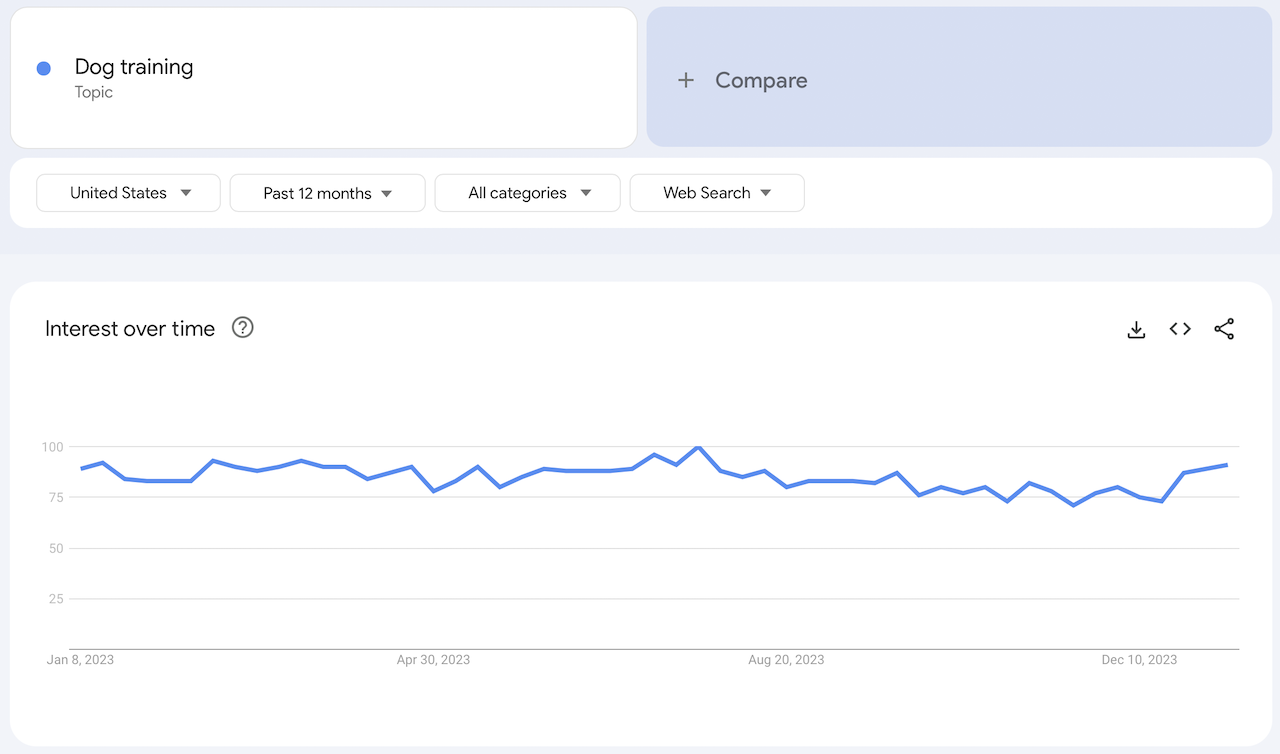
The demand is real. “Dog training” gets 165,000 searches a month in the US with a $6.46 CPC, and “puppy training” another 33,100 (Google Ads data, October 2026). Owners want a better-behaved, happier dog and they’ll pay for help, which makes this one of the safest bets in the pet market. The chart below shows how interest has held up over the years.
These are the sub-niches I’d look at first:
Profitable sub niche ideas
- Puppy socialization and basic obedience, starting from the first weeks at home.
- Service dog training for people with disabilities, built around the tasks each person needs. It gets 40,500 searches a month in the US.
- Agility training for owners who want to compete in dog sports.
- Behavior problems like aggression, excessive barking, fear or separation anxiety (74,000 searches a month for that last one).
- Training programs designed around the traits of one specific breed.
- Virtual dog training by video call, for owners who prefer remote sessions.
- Eco-friendly training with sustainable treats, toys and gear.
- Therapy dog training for hospitals, nursing homes and schools.
- Trick training for owners who want something fun and a bit more advanced.
- Rescue and shelter dogs, helping them settle into a new home and become easier to adopt.
Who is this niche for? Dog owners who enjoy the topic and can show real results, ideally with photos or videos of their own dog. If you only rewrite what other sites say, readers will notice. The best money comes from training courses, your own or affiliate ones, plus gear like harnesses and GPS trackers.
3. Maternity Clothing.
Babies keep coming, even in years when birth rates drop. The US recorded 3,606,400 births in 2025, 1% fewer than in 2024, according to the CDC. That is still millions of new parents every single year.
And spending starts long before the baby arrives. Expectant parents buy clothes, gear and furniture months in advance. The maternity niche has been stable and profitable for years, with small dips when birth rates fall.
Bloggers have noticed, so this niche is busier than it used to be. “Maternity clothes” gets 135,000 US searches a month, and Google Ads rates the advertiser competition as high. To stand out in the search results you need a real angle, like plus-size, workwear or honest reviews from mothers who wore the clothes.
The good news is that the long tail is wide. Some sub-niches with buyers behind them:
Profitable sub niche ideas
- Organic and eco-friendly maternity wear for mothers who care about materials.
- Maternity activewear that is comfortable and supportive enough to keep exercising during pregnancy.
- Plus-size maternity clothing, a segment many brands still underserve (6,600 searches a month).
- Maternity workwear for women who need to look professional at the office (6,600 searches, $3.20 CPC).
- Dresses and outfits for baby showers, weddings and formal events. “Maternity dresses for baby shower” gets 27,100 searches a month.
- Maternity clothing inspired by specific cultures and traditions.
- Postpartum clothes, including nursing-friendly and recovery wear.
- Maternity wear rental, so mothers can wear nice outfits without buying clothes they’ll use for a few months.
- Clothing for mothers expecting twins or multiples, with extra support and comfort.
- Customizable and DIY maternity wear for crafty moms-to-be.
This one works best for parents who have been through it, or for a writer willing to interview real mothers. Generic product roundups won’t beat the big parenting sites. Amazon links and the affiliate programs of maternity brands are the obvious ways to monetize, and a rental or resale angle can become a small business of its own.
4. Environmentally Friendly
The environmentally friendly niche keeps growing and still has room for new players. Why?
- People care more about the environment every year, and many now look for a green alternative first.
- Eco-friendly products give a brand an easy way to stand out and earn loyal customers.
- The niche rewards new ideas, and sustainable businesses tend to age well.
- Many governments encourage sustainable practices with new rules and financial incentives.
- Green practices improve a company’s image with customers, investors and even its own employees.
Search demand is spread across many products. “Eco friendly cleaning products” gets 18,100 US searches a month with a $4.57 CPC, while “shampoo bars” and “bamboo toothbrush” get 14,800 and 12,100. Some ideas:
Profitable sub niche ideas
- Non-toxic, biodegradable cleaning products made with natural ingredients.
- Sustainable fashion made from organic, recycled or upcycled materials.
- Zero-waste personal care: shampoo bars, bamboo toothbrushes and biodegradable sanitary products.
- Eco-friendly baby products like organic cotton clothes, natural baby care and biodegradable diapers.
- Green gardening with organic fertilizers, non-toxic pest control and heirloom seeds.
- Sustainable office supplies, from recycled paper to biodegradable pens.
- Eco-friendly pet products, such as biodegradable waste bags, organic pet food and toys made from recycled materials.
- Solar-powered gadgets like chargers, lights and camping gear.
- Sustainable travel accessories, such as reusable bottles, solar backpacks and eco-friendly luggage.
- Energy-efficient appliances for homeowners who want lower bills and a smaller carbon footprint.
A word of caution: eco-friendly buyers are quick to spot greenwashing. Check the materials and certifications of a product before you recommend it. Done right, this is a niche where an honest, picky site can earn the kind of trust the big stores never get.
5. Van life.
Van life is a community of people who traded a fixed home for a van. Less stuff, more simplicity and a lot more adventure.
Social media shows the pretty side. The reality includes breakdowns, cold nights and hunting for a place to park. Even so, its popularity has grown a lot in recent years, partly because you can have a real adventure without going very far from home.
In Google Trends, interest in van life has been growing steadily, and the niche is still young. That is why I think the competition is still beatable. “Van life” gets 14,800 US searches a month and “van conversion” 3,600 (Google Ads data, October 2026). Small numbers, but the people behind them are about to spend thousands on a van.
Instagram plays a big part. It is where van lifers share their builds and trips, and those photos keep bringing new people in. Most of them are not driving across continents, either. They love the lifestyle and the experiences, even close to home.
Some sub-niches with low difficulty:
Profitable sub niche ideas
- Custom van conversions that turn a regular van into a fully equipped home on wheels.
- Off-grid solutions like solar power setups, insulation and composting toilets.
- Compact appliances such as mini fridges, portable stoves and space-saving kitchen gadgets.
- Interior design for vans, where every inch counts.
- Travel guides and itineraries for van lifers, with routes, stops and tips.
- Remote work from a van: mobile internet, a workspace that doesn’t hurt your back and power management.
- Workshops on vehicle maintenance, off-grid living and safety on the road.
- Fitness on the road, with compact equipment and simple routines.
- Communities and meetups where van lifers connect and travel together.
- Adventure gear rental, such as bikes, kayaks and hiking gear.
Who shouldn’t pick this one? Anyone who has never slept in a van. Van lifers can tell in one paragraph whether you have done it, and the best content here comes from real builds and real trips. If you have that experience, affiliate links to gear and paid build guides can pay well.
6. Home Fitness.
The home fitness niche keeps growing as people pay more attention to health and wellness. Working out at home is convenient and private. The COVID-19 pandemic closed gyms and pushed millions of people to train at home, and many never went back. Smart equipment, wearables and fitness apps have made home workouts better, too.
The interesting part is the audiences. Seniors, new parents and people with specific goals all want solutions made for them. Generic terms are expensive: “home gym equipment” gets 90,500 searches with a $3.59 CPC, and “adjustable dumbbells” 110,000. Narrow terms are where a new site has a chance, like “exercises for seniors at home” (1,300 searches) or “postpartum workout” (2,900, with a $7.13 CPC).
Sub-niches worth a look:
Profitable sub niche ideas
- Compact, easy-to-store equipment for small apartments.
- Virtual personal training over video calls.
- Home workouts and equipment designed for seniors.
- Postpartum fitness programs for new mothers.
- Yoga and meditation classes at home, online or in person.
- Fun fitness routines that get kids moving.
- Rehab equipment and exercises for recovering from injuries or surgery.
- HIIT kits for home use, with equipment and guided routines.
- Workout programs combined with personalized nutrition plans.
- Eco-friendly fitness equipment and accessories.
I’d go for one audience and one problem, like home workouts for seniors with bad knees, instead of trying to compete with the big fitness brands. The more specific you are, the easier it is to rank, and to sell a program or the right piece of equipment.
7. Fast Recipes.
Most people don’t have an hour to cook on a weeknight. They want quick, easy meals that are still healthy and tasty, and that need is what makes fast recipes a profitable niche. “Quick dinner ideas” gets 74,000 US searches a month and “one pot meals” 40,500.
Is it low competition? The main terms aren’t. But the niche splits into lots of sub-niches (healthy, vegan, budget, one cuisine, one appliance), and each of them leaves room for a focused site. CPCs are low here, under $1 for most recipe keywords, so plan to earn from display ads and from affiliate links to kitchen gear. That second part is what I do with chefgadgetgenius.com, my Amazon affiliate site about kitchen gadgets.
You’ll find more food niche ideas in my report.
Some angles with less competition:
Profitable sub niche ideas
- 5-ingredient meals for people who hate long shopping lists (5,400 searches a month).
- One-pot meals with almost no cleanup.
- Healthy fast recipes for people who train.
- Quick vegan and vegetarian recipes.
- Fast family meals for working parents that kids actually eat.
- Quick versions of dishes from other countries.
- Microwave recipes for students and tiny kitchens.
- 15-minute meal preps.
- Smoothies and healthy drinks for a quick boost.
- No-cook recipes like salads, wraps and sandwiches.
The downside? Recipe sites live on traffic, and traffic takes time. If you need money in three months, this isn’t your niche. If you are patient and enjoy cooking, a focused recipe site can grow into a solid asset.
8. Massage Chairs.
Who doesn’t enjoy some quiet time at home after work? Now add a massage to it. Bingo!
Massage chairs sell because people want to relax and ease their aches without booking a therapist. A chair brings the massage home, and the technology keeps getting better. Buyers go from office workers to older people with chronic pain. The money is in the price tag: a good chair can cost thousands of dollars, so each affiliate sale is worth a lot more than a kitchen gadget.
Is the competition low? For “massage chair” (110,000 searches) and “best massage chair” (9,900, $4.74 CPC), no. Big review sites are already there. But there is room for a site that focuses on one feature, one type of home or one type of user.
Easier angles:
Profitable sub niche ideas
- Compact chairs for apartments and small homes.
- Eco-friendly chairs with sustainable materials and lower energy use.
- Chairs for specific problems like lower back pain, a stiff neck or poor circulation.
- Smart chairs controlled from a phone app, with custom programs.
- Office massage chairs with discreet, ergonomic designs.
- Chairs for older users, with gentle programs and simple controls.
- Massage pads that go on the chair you already have. “Massage chair pad” gets 2,900 searches a month.
- Luxury designer chairs for the high-end market.
- Chairs with aromatherapy built in.
- Recovery chairs for athletes and people who train hard.
My advice: pick an angle where you can add something the big sites can’t, like measurements of chairs that fit small apartments or honest comparisons for very tall people. Commissions on expensive products mean you don’t need huge traffic to make it worth it.
9. AI Marketing
AI marketing is growing fast because companies want AI to target better, personalize campaigns and automate repetitive work. Pretty much every business that sells online is asking how to use it.
Now the honest part. This used to be a low competition niche, and that has changed. “AI marketing tools” has a $35.34 CPC in the US and “ai chatbot for website” $51.52 (Google Ads data, October 2026). Clicks that expensive mean software companies with big budgets are fighting for these searches. You need real expertise to compete, and the tools change every few months. I’d skip this one unless you work in marketing or tech and can test the tools yourself.
If you do have that background, these are the angles I’d look at:
Profitable sub niche ideas
- AI tools that help write web content, blog posts and ad copy.
- Predictive analytics that anticipate what customers will buy next.
- Chatbots for customer service on websites and social media.
- AI for email marketing, from personalization to better open rates.
- Tools that analyze social media trends, sentiment and competitors.
- Voice search optimization for devices like Google Home and Amazon Alexa.
- Automated ad targeting and bidding.
- Customer journey mapping with AI.
- AI video tools. “AI video generator” gets 246,000 searches a month with a $5.67 CPC.
- Real-time personalization for websites based on user behavior.
One more thing about this niche: content goes out of date fast. Whatever you publish about a tool this month may be wrong in six months, so set aside time for updates.
10. Home Automation.
Home automation sells convenience, security and lower energy bills. People want to control lights, heating and locks from their phone, and smart home tech gets cheaper every year. “Smart home devices” gets 165,000 US searches a month, “smart thermostat” 201,000 and “smart lock” 110,000.
Here’s the interesting bit: Google Ads rates the advertiser competition for “smart home devices” and “smart lock” as low. New devices launch all the time, so there are always fresh topics to cover. The gaps are in specific uses, like energy-saving setups, systems for particular groups of people, or getting devices from different brands to work together.
Some ideas:
Profitable sub niche ideas
- Energy-saving smart home products: thermostats, lighting and solar-connected devices.
- Automation for elderly and disabled people, like voice control, medication dispensers and emergency alerts.
- Smart security with locks, cameras and alarms you manage from your phone.
- Automated indoor gardens with smart watering and grow lights (“indoor garden system” gets 5,400 searches).
- Smart kitchen appliances you can control and monitor remotely.
- Home entertainment systems that bring TV, audio and streaming into one easy interface.
- Voice-controlled homes.
- Custom smart home setups designed around one house and one family.
- Remote monitoring for people who travel a lot or own several properties.
- Eco-friendly smart home products.
This is a good fit for people who like to tinker. Write tutorials that solve real setup problems, like devices that won’t connect or automations that keep breaking, and you’ll get traffic that product pages never get. Affiliate links to the devices you recommend do the rest.
You might want to read now:
How to monetize these low competition niches
Ok, so you’ve picked your niche. How do you make money from it?
- Join affiliate programs and earn a commission on every sale you refer. My site chefgadgetgenius.com works this way with Amazon.
- Sell your own products, physical or digital, like ebooks, courses or software.
- Offer consulting or coaching if you know the niche well.
- Run a membership site or subscription with exclusive content, products or services.
- Show ads on your blog or YouTube channel. I’ve used Google AdSense, and it only pays well once you have a lot of traffic.
- Get paid for sponsored posts, articles or videos by brands in your niche.
- Try dropshipping, where you sell the products and a supplier stores and ships them. I’ve used Sellvia for this.
- Create online courses, webinars or workshops.
- Open an online store with niche products.
- Work as a freelancer in your niche, writing, designing or doing marketing.
Are you ready to start your profitable niche with low competition?
That’s the list: ten profitable niches with low competition and 100 sub-niches to start from.
My verdict? If you’re starting from zero, dog training, maternity clothing and fast recipes are the easiest to rank in with good content, and the buyers are clear. Skip AI marketing unless you have the background, and skip wearables if you don’t want to keep updating your posts.
Pick one, run it through the seven steps above and check the numbers yourself before you write your first post.
Now I’d like to hear from you:
Did you find a niche on this list that fits your goals?
Tell me which one in the comments, or ask me anything you’re not sure about.
Need help finding your perfect niche?
Let me help you find THE niche, including a tailored strategy plan for growth!
FAQs