
Pet Niche Report (2026): Market Size, Sub-Niches and Ways to Make Money
In this report, you will learn:
How big the pet market really is (2025 figures)
What is growing and what is saturated
2026 search demand for 30+ pet sub-niches
How pet sites actually make money
Micro-niche ideas you can still rank for
Last updated: September 22, 2026 (new APPA market figures, 2026 search data for pet sub-niches, a rewritten monetization section and a shorter, curated idea list).

Section 1.
The Pet Niche Market in 2026.
How big it is, where the money goes and who ranks today.

The pet industry is one of the few consumer markets that kept growing through inflation. According to the American Pet Products Association (APPA), US pet industry spending reached $158 billion in 2025, up 3.7% on the previous year, and APPA projects $165 billion for 2026. About 95 million US households own at least one pet.
Here is where that money goes, using APPA’s 2025 breakdown:
| Category | 2025 US spending |
|---|---|
| Pet food & treats | $68.3 billion |
| Vet care & product sales | $41.0 billion |
| Supplies, live animals & OTC medicine | $34.4 billion |
| Other services (grooming, boarding, training, sitting, insurance…) | $14.3 billion |
Two things stand out when you look at those numbers as a niche site owner rather than an investor:
- Food is the biggest slice, and the most crowded one. Brands, retailers and review sites already fight over every “best dog food” query. Unless you have real expertise (a vet, a nutritionist, a breeder), food is a hard place to start.
- Services are the smallest slice, but the most local and the least saturated online. Grooming, training, sitting and boarding are searched with local or problem-based intent, which is exactly where small sites and small businesses can compete.
Not everything is rosy. The same APPA report says 22% of pet owners spent less in 2025 than the year before. That matters for content: “affordable”, “worth it”, “vs” and “DIY” angles are getting more attention, and pure luxury product roundups are a weaker bet than they were in 2021.

Who ranks for “pet niche” today
Before updating this report I checked the US Google results for “pet niche” and “niche pet” (September 2026). The first page is a mix of Shopify demo stores, a Reddit thread in r/dropshipping, dropshipping supplier blogs (AppScenic, Sourcinbox) and pet-retail trade blogs, with an AI Overview on top. “Niche pet” also pulls in people asking which unusual animal to keep.
In other words, most people searching this want to start a pet business or store, not read about cute animals. That is the angle this report takes.
Section 2.
Pet Niche Trends.
What is growing, what is flat and what that means for a new site.

Trend tools tell you whether interest in a topic is growing, stable or fading. For pets, the long-term picture is stable and high: people do not stop feeding or caring for their animals when the economy slows down. What moves is which animals and which problems get attention.
Trends worth paying attention to
- Cats are growing faster than before. APPA counts 53 million cat-owning households in 2025, up 5% year over year, and says products remain the top expense for cat owners. Cat content is still less crowded than dog content on most keywords.
- Smaller and exotic pets are rising with older owners. Among Gen X households, APPA reports year-over-year growth of 25% for birds, 20% for reptiles and 17% for freshwater fish. Aquarium and reptile keepers are research-heavy buyers, which suits content sites.
- Fresh and premium food keeps attracting advertisers. In our 2026 keyword pull, “fresh dog food” has a US cost per click above $31, one of the highest in the whole niche. High CPC means brands pay a lot for that traffic, and it also means affiliate and review content there is very competitive.
- Value-seeking is back. With a fifth of owners cutting spending, comparison and budget content (“is X worth it”, “cheaper alternative to X”) has an audience again.
To check any of these yourself, use Google Trends: search a topic (for example “Pet”) rather than a search term, set the period to five years and look at the shape of the line. A steady or rising line is fine; a line that spikes and drops back to zero is a fad. I explain the method in more detail in my guide to niche trends.
Trends only tell you about interest, though. You still need to niche down and check competition, which is what the next sections are about. If you are new to this, start with the niche research guide and the advantages of niche marketing.
Section 3.
How to Find Pet Niche Ideas.
A simple, free method you can repeat for any sub-niche.

There are many methods you can use to find out exciting sub-niches ideas. The simplest one might be a combination of Wikipedia with Google Suggest to find ideas. Then you validate them with Google Trends and a quick look at the search results.
This is how to do it:
Step #1. Head to Wikipedia, and in the search bar, type your niche keyword and hit search.
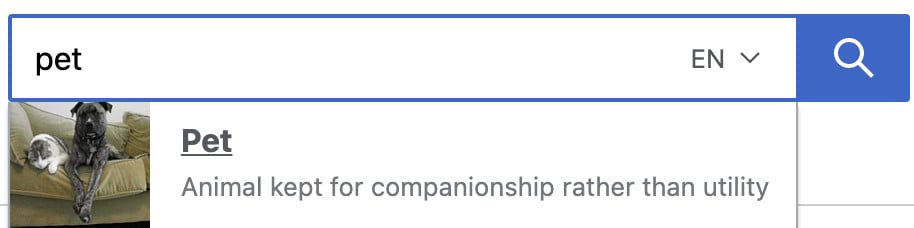
Step #2. Skim the page for sub-niche ideas. You’ll be able to find plenty of pet-related keywords. Some places where to look include the table of content, in the content itself, and in the see also section at the bottom.
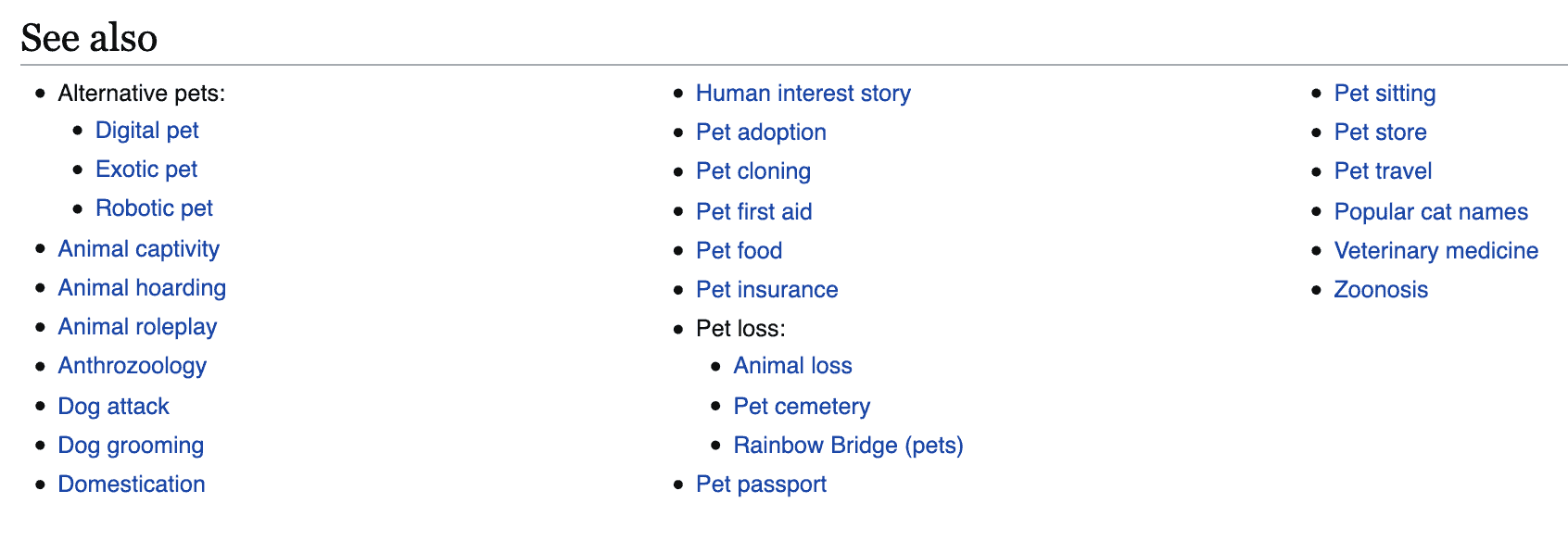
Also, when you click on a pet-related term with a link, it will take you to another page where you’ll be able to find even more ideas. So this is an excellent method to brainstorm keywords and sub-niche ideas.
Step #3. Next, you can complete these sub-niche ideas with Google Search. Head to Google.com and enter some of your niche keywords. Google will instantly suggest some sub-niches for you.
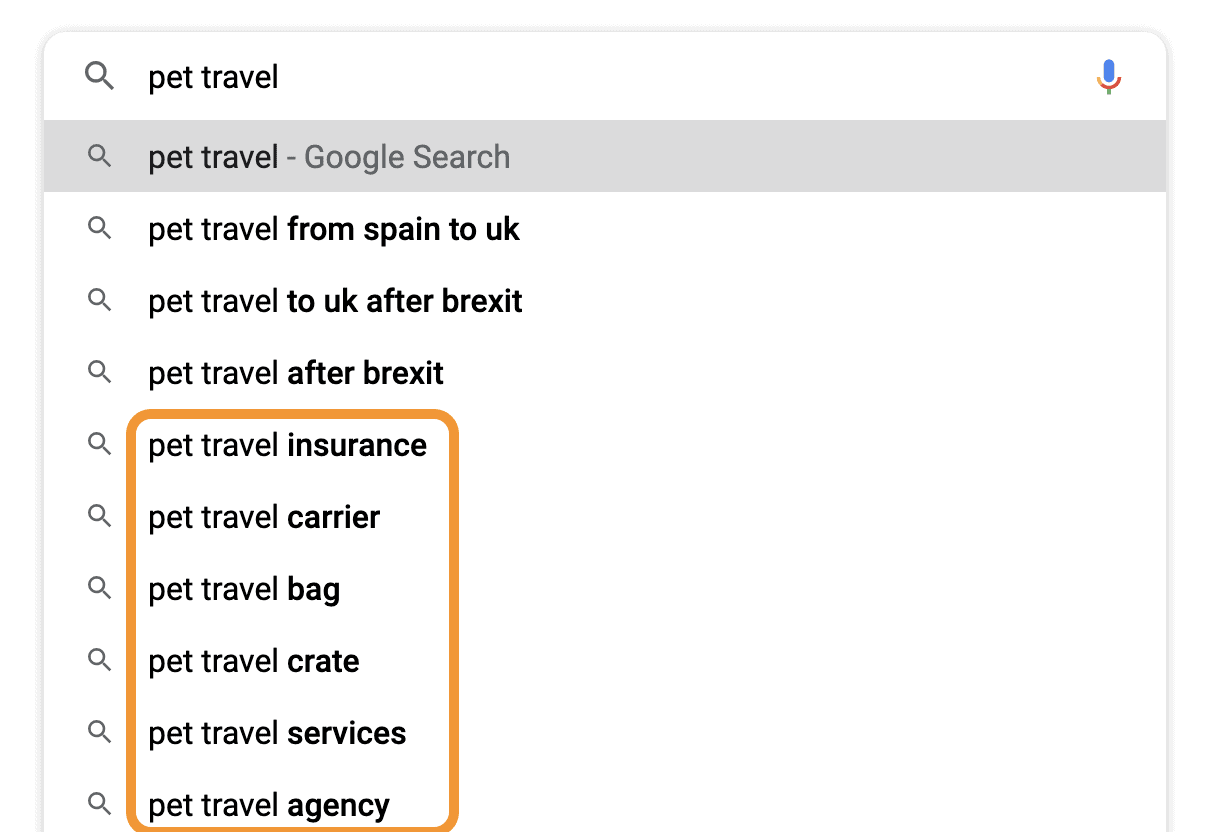
You can even keep niching them down as you type:
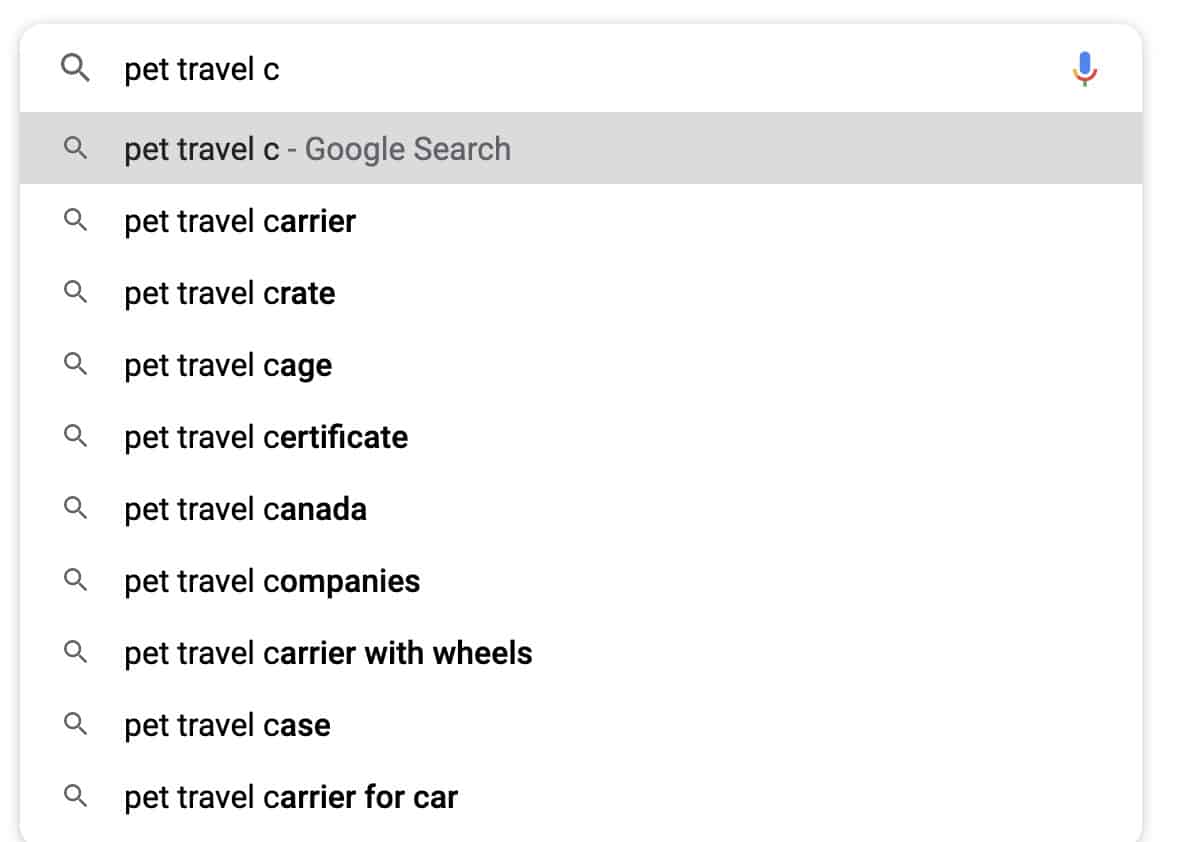
This is a very effective and easy trick to find sub-niche and micro-niche ideas.
Step #4. Use Google Trends to validate your niche idea. Following this example, I will check “Pet travel carrier.“
When I first ran this check (the screenshots in this section are from 2021), interest in pet travel carriers was recovering after the travel slowdown of 2020. The method is the same today; only the numbers change.
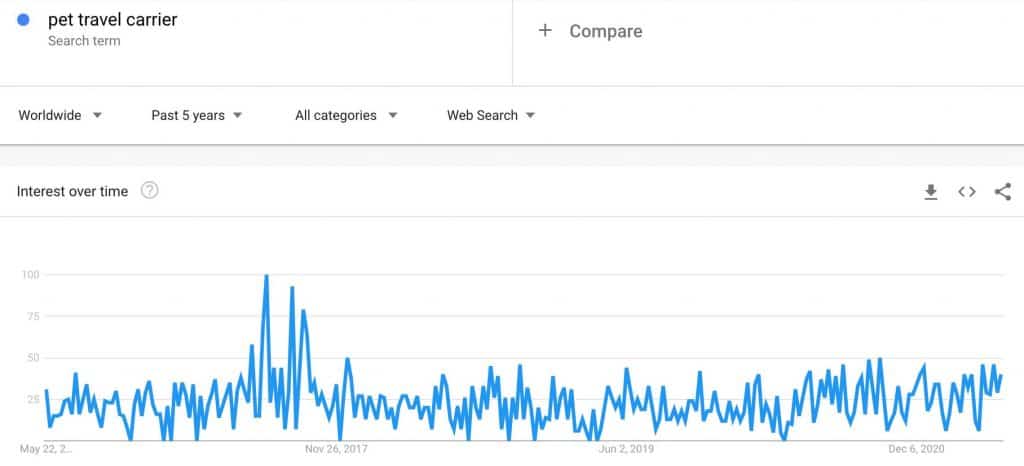
Additionally, you could also include in the Google Trends search bar a few terms from your Google suggestions or your Wikipedia keywords to be able to visually compare your ideas.
For this example, I have used pet travel, pet insurance, and pet food.
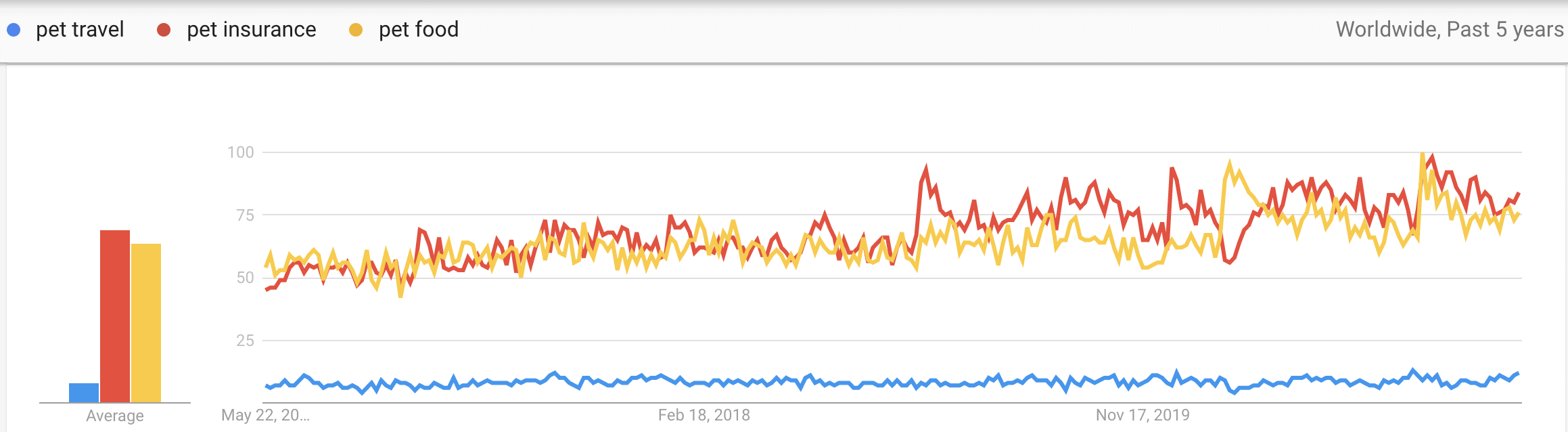
As you can see, all these trends seem pretty stable, with a dominant interest in insurance and food. This will probably mean it will also be more competitive.
Normally, the higher the interest over time, the higher the competition as well. So it is vital to find a sub-niche or micro-niche in the sweet spot between search volume and commercial value, more on this in the next section.
In any case, this is a very effective method to quickly find sub-niche and micro-niche ideas in any industry.
Lastly, note that trends that are just starting to grow are the ones with the most potential. It could be a new market blooming, meaning the competition is inexistent or limited. So do not drop ideas only because trends show low numbers. If the trend’s interest grows exponentially and gets stable, it is probably worth pursuing.
Step #5. Look at who ranks. Search your idea on Google and note what the first page is made of. Big retailers and brand pages mean a hard fight; forums, Reddit threads, thin listicles and small blogs mean there is room for a better page. This takes two minutes and saves you from building a site around a keyword you can never win.
Section 4.
Pet Niche Competition.
Who you are really up against, and where the gaps are.

Any niche with this much money in it has strong players. For head terms like “dog food”, “cat tree” or “pet insurance” you are competing with Chewy, Petco, PetSmart, Amazon, the brands themselves and big media sites. A new site will not rank for those, and it does not need to.
The good news is that pet buyers search in a very specific way. They do not only search “dog bed”; they search for their dog, their problem and their situation: a bed for a senior dog with arthritis, a carrier that fits under an airline seat, a litter box that works for two cats in a small apartment. Every one of those qualifiers cuts the competition down.
Three filters I use to find the gaps
- Species first, then problem. Go from “pets” to one animal, then to one problem or life stage: senior dogs, anxious dogs, indoor cats, bearded dragons, planted aquariums.
- Look for weak results, not low volume. A keyword with 1,000 searches where page one is Reddit and thin listicles is better than one with 100 searches owned by Chewy and the AKC.
- Check the commercial value. A high cost per click tells you advertisers make money from that traffic. Informational topics with zero CPC can still build an audience, but they are harder to monetize.
For the full process, see how I do niche keyword research and how to analyze your niche competitors. If you want ideas outside pets, I keep a list of profitable niches with low competition.
One warning about pet health. Content about symptoms, medication, diets for sick animals or toxic foods is treated by Google as content where accuracy really matters. If you cover it, cite veterinary sources, have it reviewed by someone qualified, and never present guesses as advice.
Section 5.
How to Make Money in the Pet Niche.
The business models that fit pet audiences, with real examples.

There are several ways to monetize a niche website, but in the pet niche the best one depends on the intent behind your keywords. Someone searching “dog daycare near me” wants a service; someone searching “best automatic litter box” is ready to buy a product; someone searching “why does my cat knead” wants an answer and may buy later.
Most pet sites combine two or three of these:
1. Services
Grooming, training, pet sitting, dog walking and daycare are local businesses, and the web is where people find them. If you run (or want to run) one of these, a small site that answers local questions well can bring in clients directly. Some training can also be sold online: puppy training courses and behavior consultations over video are common now.
Examples: Rover and Wag (marketplaces for sitters and walkers), Fetch! Pet Care (a pet-sitting franchise) and PetSmart (grooming and training in store).
Related: how to create and sell an online course.
2. Physical products and ecommerce
Pet supplies are one of the most popular categories for new online stores, and the search results for “pet niche” are full of dropshipping content for that reason. It can work, but go in with open eyes: shipping costs kill margins on heavy items like litter and food, and pet food is regulated in the US by the FDA. Accessories, beds, travel gear, grooming tools and products for a specific animal (reptile heating, aquarium equipment) are usually easier.
Examples: Chewy and Zooplus (large online pet retailers). If you are exploring stores, see my lists of the best dropshipping niches and the best Shopify niches.
3. Digital products
Training plans, feeding schedules, printable health logs for a new puppy, care guides for a specific reptile: small digital products solve real problems and cost almost nothing to deliver. The key is being specific. “Dog training ebook” is a crowded idea; “a 4-week plan for leash pulling in large breeds” is a product. More on this in my digital product creation guide.
4. Subscriptions and boxes
Pet owners buy the same things every month, which makes subscriptions a natural fit. Examples: BarkBox and Pupjoy for dogs, Meowbox for cats. For a content site, a paid membership (a community for new puppy owners, a club for reef aquarium keepers) is the equivalent model.
5. Affiliate marketing
Pet retailers and many pet brands run affiliate programs, and Amazon Associates covers almost any pet product. Commissions on pet supplies are usually modest, so affiliate sites here need either volume or a focus on higher-priced items (GPS collars, pet cameras, automatic litter boxes, aquarium setups). Honest comparisons of products you have actually used are what separate a useful review site from the thousands of thin ones.
If you are new to affiliates, start with the best affiliate marketing niches and Pinterest affiliate marketing (pet content does very well on Pinterest).
6. Display ads
Pet content gets a lot of informational traffic (behavior questions, “can dogs eat…” questions, breed guides), which suits display advertising once you have enough visitors. Ads rarely pay the bills on their own for a small site, so treat them as a second income on top of one of the models above. See my list of the best AdSense niches for how pets compare with other topics.

Section 6.
Pet Sub-Niche and Micro-Niche Ideas.
Backed by 2026 US search data, not guesswork.

To update this list I pulled US search data for more than 30 pet keywords in September 2026. Use the volumes to see how big each sub-niche is and the cost per click (CPC) to see how much advertisers pay for that traffic. Remember that the head terms below are dominated by big players: the table tells you where demand is, and the micro-niches under each one are where you can actually compete.
| Sub-niche | Example keyword | US searches / month | CPC |
|---|---|---|---|
| Insurance | pet insurance | 246,000 | $36.34 |
| Food | dog food | 246,000 | $8.13 |
| Food | fresh dog food | 40,500 | $31.24 |
| Food | raw dog food | 33,100 | $13.48 |
| Food | freeze dried dog food | 27,100 | $8.31 |
| Treats | dog treats | 90,500 | $2.25 |
| Treats | dog dental chews | 22,200 | $2.62 |
| Treats | dog birthday cake | 27,100 | $1.25 |
| Health | dog anxiety | 22,200 | $2.31 |
| Health | pet supplements | 2,900 | $4.17 |
| Health | senior dog | 2,900 | $1.24 |
| Cat supplies | cat tree | 135,000 | $1.23 |
| Cat supplies | cat litter | 90,500 | $2.09 |
| Cat supplies | automatic litter box | 74,000 | $2.84 |
| Dog supplies | dog bed | 110,000 | $2.04 |
| Dog supplies | dog harness | 60,500 | $2.34 |
| Tech | gps dog collar | 22,200 | $7.45 |
| Tech | pet camera | 12,100 | $1.74 |
| Services | dog grooming | 201,000 | $2.82 |
| Services | dog training | 165,000 | $6.46 |
| Services | puppy training | 33,100 | $4.89 |
| Services | dog daycare | 74,000 | $4.79 |
| Services | pet sitting | 40,500 | $7.11 |
| Services | dog walker | 27,100 | $7.19 |
| Travel | pet friendly hotels | 90,500 | $2.62 |
| Travel | airline approved pet carrier | 6,600 | $1.11 |
| Travel | pet stroller | 14,800 | $0.70 |
| Exotic & aquatic | aquarium | 550,000 | $0.85 |
| Exotic & aquatic | bearded dragon | 368,000 | $0.46 |
| Exotic & aquatic | reptile supplies | 3,600 | $1.21 |
| Backyard | chicken coop | 201,000 | $0.87 |
| Memorial & art | pet portrait | 12,100 | $3.31 |
| Memorial & art | pet memorial | 6,600 | $2.32 |
| Business | pet subscription box | 590 | $6.19 |
Sub-niche: pet insurance
Very high CPC (above $36 in our data) and very high competition from insurers and comparison sites. Only realistic if you narrow it hard: insurance for a specific breed with known health issues, insurance for older pets, or honest explanations of how claims and waiting periods work.
Micro-niches: cat insurance, insurance for senior dogs, exotic pet insurance, breed-specific cover. Best fit: affiliate/lead generation, ads.
Sub-niche: pet food and treats
The biggest spending category and the most crowded search results. Fresh, raw and freeze-dried food all have strong demand and high CPCs. Treats are easier: “dog birthday cake” alone gets around 27,000 searches a month and is a lovely niche for a bakery, a recipe site or a small ecommerce store.
Micro-niches: homemade dog treats, dog birthday cakes, dental chews, food for a specific condition (reviewed by a vet). Best fit: ecommerce, recipes and ads, affiliate.
Sub-niche: pet supplies and tech
Cat trees, beds, harnesses and litter all get tens of thousands of searches. Tech products such as GPS collars and pet cameras have fewer searches but higher prices, which makes each affiliate sale worth more.
Micro-niches: products for small apartments, multi-cat households, large breeds, senior pets; GPS collars for hunting dogs; cameras with treat dispensers. Best fit: affiliate reviews, ecommerce.
Sub-niche: pet care services
Grooming, training, daycare, sitting and walking all have big national volumes, but the real searches are local (“near me” and city names). This is the best sub-niche if you run or want to run a local service business.
Micro-niches: mobile grooming, cat sitting, puppy socialization classes, reactive dog training, dog walking for a specific neighborhood. Best fit: services, online courses, lead generation.
Sub-niche: pet travel
“Pet friendly hotels” gets around 90,000 searches a month in the US, and airline carrier rules change often enough that up-to-date guides stay useful. A travel blog written by someone who actually travels with their dog has an edge here that big retailers cannot copy.
Micro-niches: dog-friendly road trips, airline pet policies, pet passports for international moves, pet strollers for older dogs. Best fit: affiliate (hotels, gear), ads.
Sub-niche: aquariums, reptiles and backyard animals
This is where I see the most room for new sites. “Aquarium” and “bearded dragon” have huge volumes, keepers spend a lot on equipment, and the results are often forums and old care sheets. Backyard chickens (“chicken coop” gets around 200,000 searches a month) are a whole niche of their own.
Micro-niches: nano and planted tanks, bearded dragon setups, leopard gecko care, backyard chickens in small gardens. Best fit: affiliate (equipment), digital guides, ads.
More pet niche ideas with less competition
A shorter list than the old “50+” version, on purpose: every idea below has search demand in 2026 and a clear audience, and none of them is just a product category with “pet” in front.
- Treats and birthday cakes for dogs
- Homemade and DIY pet food (with vet-reviewed recipes)
- Products for senior dogs and cats
- Anxious and reactive dog training
- Puppy training for first-time owners
- Indoor cat enrichment and cat trees
- Multi-cat households and litter solutions
- Pets in small apartments
- GPS collars and pet tech
- Pet cameras and home monitoring
- Mobile grooming
- Cat sitting (not only dog sitting)
- Dog-friendly travel and road trips
- Airline pet policies and carriers
- Pet passports and international moves
- Nano and planted aquariums
- Saltwater and reef tanks
- Bearded dragon and leopard gecko care
- Backyard chickens
- Rabbits and guinea pigs
- Pet birds and bird enrichment
- Pet portraits and pet-themed art
- Pet memorials and pet loss support
- Adoption and fostering guides
- Budget pet care (for the 22% cutting spending)
Pet niche FAQ
Is the pet niche profitable?
The market is: US pet spending reached $158 billion in 2025 according to APPA. Whether your site is profitable depends on picking a sub-niche where you can compete and a business model that fits the search intent. Broad “pet blogs” rarely work; focused ones do.
Is the pet niche too saturated?
At the top level, yes. “Dog food” or “pet insurance” are out of reach for a new site. But pet searches are very specific (a species, a breed, a problem, a life stage), and many of those long-tail searches still have weak results.
What is the best pet niche for a beginner?
Pick an animal you know well and a problem you have solved yourself. Senior dog care, indoor cat enrichment, bearded dragon setups and dog-friendly travel are good starting points because they combine steady demand with room for first-hand experience.
Is pet dropshipping a good idea?
It can be, with light, non-perishable products and a specific audience. Avoid heavy items where shipping eats the margin, and be careful with food, treats and anything health-related, which carry regulatory and safety responsibilities.
How do pet websites make money?
Mostly through a mix of affiliate commissions, display ads, their own products (physical or digital), subscriptions and local services. The strongest sites usually pair one main model with one secondary one.
Want a niche website built for you?
I research, build and write your niche site so it is ready to grow from day one.
Recommended Resources:
Now it’s your turn!
Did you already find your pet niche?
The pet market keeps growing, but the easy wins are gone at the top level. Pick one animal, one audience and one problem, and build the most useful site on that corner of the niche.
You will have a smaller audience at first, but it will find you faster, trust you sooner and buy more. If you want to see how the same approach works in another market, read my gaming niche report or browse more niche market examples.
If you have any questions leave a comment below.



RELATED CONTENT

Niche Selection Guide: Why Pest Control Could Be Your Next Profitable Venture
Choosing the right niche makes a huge difference in attaining long-term success. While some niches…

100 Best TikTok Niches Ideas to go viral in 2026
The best TikTok niches right now are dance, food, comedy, drawing, fitness, memes, fashion, travel,…

50 Best Youtube Niches With Low Competition to Skyrocket Your Channel
Are you looking for the best YouTube niches with low competition to start a profitable…

10 Trending Niches on YouTube: Popular Content Ideas
YouTube offers endless opportunities to create content and reach a vast audience. With so many…

10 Best DIY Niches to Launch Your Niche Website
Finding a DIY niche for your website can be both exciting and profitable. If you…

Personal Development Niche Report: 50+ Niche Ideas, Trends & Tips
Personal Development Report: 50+ Niche Ideas, Trends & Tips In this report, you will learn:…